
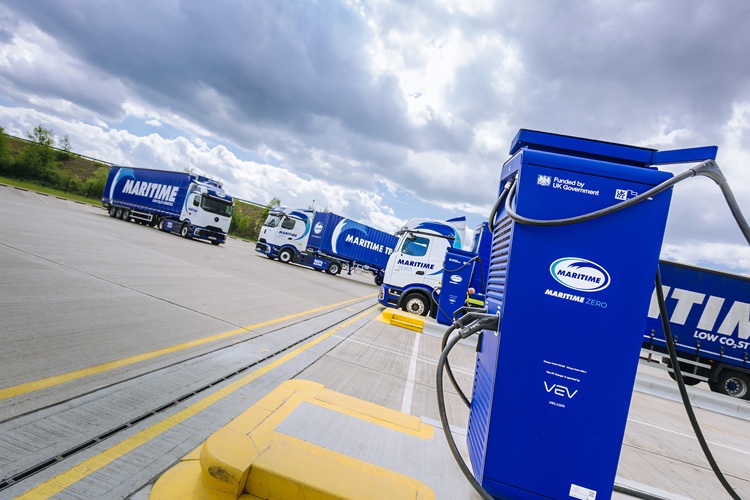
Maritime Transport and Coca-Cola Europacific Partners (CCEP) have reached a significant milestone in decarbonising GB road freight, with the first fully electric heavy goods vehicle (eHGV) now operating across CCEP’s GB logistics network.
The partnership has focused on making electrification work in practice. The two companies worked collaboratively to optimise deliveries and routes, providing the proof of concept that eHGVs can transport soft drink payloads.
The deployment marks a new phase in the long-standing partnership between the two companies and, for the first time, integrates electric road transport into CCEP’s GB domestic supply chain as part of its wider ambition to reduce value chain emissions through its sustainability action plan.
The Mercedes-Benz eActros 600 entered service in January and now operates on dedicated delivery routes from CCEP’s manufacturing site in Wakefield – Europe’s largest soft drinks plant by volume. Running five days a week, the vehicle completes multi-drop deliveries, supplying soft drinks to convenience and wholesale customers. The nature of the work, with planned routes and consistent payloads, makes it well suited to electrification. The vehicle is currently operating as a proof of concept, with performance being closely monitored as both businesses assess how electric vehicles can be applied more widely across CCEP’s network.
Since entering service, the eHGV has travelled more than 7,000 miles, saving an estimated 12.43 tonnes of CO2e compared to equivalent diesel journeys. Charging takes place at Maritime’s transport depot in Wakefield, where high-powered infrastructure has already been installed to support the company’s growing electric fleet, using electricity sourced from 100% renewable energy across the business.
The initiative forms part of Maritime’s wider investment in decarbonising road freight through Maritime ZERO, its zero-emission road transport division. Delivered in part through the government-backed Zero Emission HGV and Infrastructure Demonstrator (ZEHID) programme, Maritime is introducing 56 eHGVs across its national network during 2026, alongside the development of one of the country’s largest independent charging networks with more than 22MW of installed power once complete. Rollout is already underway, with 12 eHGVs now in operation at Wakefield – the first site to go live – a further 10 based at Maritime’s rail terminal in Tamworth, and two eHGVs at East Midlands Gateway. Additional locations will follow and be energised over the coming weeks and months.
For CCEP, initiatives of this kind are central to its This is Forward action plan, which sits at the heart of its long-term business strategy. The company has committed to reaching net zero greenhouse gas emissions across its entire value chain (Scopes 1, 2 and 3) by 2040, alongside a 30% reduction target by 2030. Transport, including fleet and third-party distribution, accounts for around 10% of its total carbon footprint. As a result, the business is focused on transitioning to electric and ultra-low emission vehicles, optimising transport routes, and working closely with logistics partners to drive down emissions.
CCEP is supportive of UK Government ambitions to decarbonise HGV transport in the UK and is part of the Climate Group business coalition EV100, which looks to support the transition to electric vehicles. As the UK Government seeks to phase out the sale of non-zero emissions HGVs by 2040, action is now required to create reforms allowing eHGVs to carry heavier loads to maximise load capacity, reduce carbon emissions and repeat deliveries.
Maritime has supported CCEP’s GB distribution operations since 2014, with the partnership evolving significantly in recent years as both companies have intensified efforts to reduce supply chain emissions. In 2022, the relationship expanded to include rail, with Maritime launching a domestic distribution service between its terminals in Wakefield and at the Port of Tilbury. Operating six days a week as part of an integrated road and rail solution, the rail service removes millions of road miles annually and cuts carbon emissions by close to 50% compared to a road-only model.
Maritime and CCEP are now exploring opportunities to expand the use of eHGVs, including the potential deployment of additional vehicles in the South as Maritime’s charging infrastructure develops and as the initial deployment is evaluated.
Tom Williams, Deputy Chief Executive Officer, Maritime Transport, said:
“This is an exciting next step in our relationship with CCEP. Having worked closely across both road and rail for several years, introducing an eHGV into live service is a natural progression. Together, we’re very much focused on reducing emissions across the supply chain through a combination of modal shift, low-emission fuels, and the adoption of new vehicle technologies. Having the Mercedes out on the road allows us to assess its performance in real operating conditions, understand where it delivers the greatest value, and explore how it can support our wider decarbonisation ambitions over time.”
Nick Hayward, Logistics Director, Coca-Cola Europacific Partners, added:
“We’re continuing to invest across our operations to build a more sustainable and resilient supply chain, with initiatives like this playing an important role in how we deliver against our commitments. By working with expert partners like Maritime, we can strengthen our capabilities and make meaningful progress towards our long-term sustainability ambitions.”
Maritime Transport is exhibiting at Multimodal on stand 5030